
Quick access

Melissa and Comete @ Romy Moret
Melissa and Comete @ Romy Moret
High above Bruson, all eyes around the enclosure are on the cows, reunited after several months spent in different herds. Some amble in calmly, others are already showing their temperament. Barely together, the first fights break out. Welcome to the inalpe, the early-June gathering that marks the start of summer in the mountains of Val de Bagnes every year.
For visitors like you, it’s a fascinating spectacle. For the breeders, it’s the culmination of months of work. At Mille, more than 100 Hérens cows from different herds across the region will share the mountain for 100 days. Their natural goal : to establish a pecking order and decide who will become queen of the alpage.
Among the owners and breeders, Mélissa Uttinger keeps a close eye on her protégées Comète, Tatenka and Dira. For her, this day opens a season full of hope. After winning the national queen title in 2024 with Faïka, she now has another ambition in sight.
“All I’d still like is to have the queen at Mille,” she confides.
A prestigious goal, because here victory isn’t decided in a few fights but over an entire summer.
For Benoît Abbet, who runs the alpage, that is exactly what makes mountain fights so special.
“It’s not like the queen fights, it’s a championship. You really have to understand that the cow who wins on the last day is the one who wins.”
At Mille, you’ll watch the cows evolve together over a hundred days. The balance of power shifts, some take charge quickly, others bide their time. Sometimes, patience makes all the difference.
“You can really admire the strategic side of the cows,” Benoît Abbet adds.
This special bond between breeders and their animals shines through in every exchange. Ask Mélissa what fascinates her about the Hérens breed and the answer comes instantly :
“They’re close to us. It’s like a pet. The only thing they’re missing is speech.”
This closeness goes a long way to explaining the passion surrounding the queens. Here, every cow has her own character, her own story and her own fans.
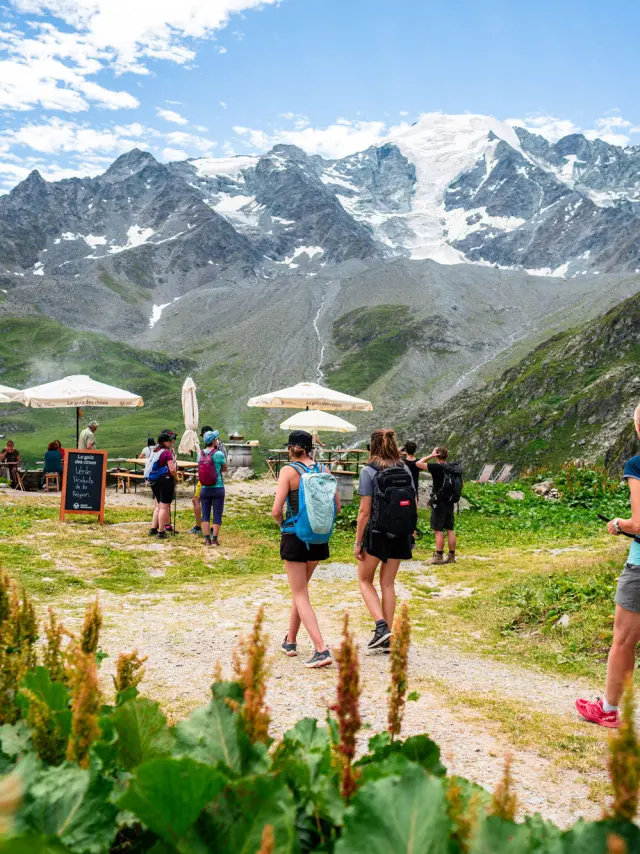
Above Verbier, Grands Plans offers an easy-to-reach escape that is nonetheless deeply rooted in the world of Valais alpages. From the Planards car park, it only takes a few minutes to reach the first barns. Keen walkers will prefer the trails climbing up from the village, then extend the outing to Croix de Cœur or along the routes that criss-cross the slopes above Verbier. Your eyes are soon drawn to the Grands Plans pastures. Ahead of you, the mountains of Val de Bagnes and the Grand Combin form a grandiose backdrop. Below, Verbier stretches across its plateau while, on the other side of the valley, the Mille alpage winks at you near the Pasay ski run.

Des Grands Plans Alpine Pasture @ Romy Moret
What makes these special places famous is, above all, their residents. Nearly 190 Hérens cows spend the summer here. An impressive figure that makes Grands Plans the largest herd made up exclusively of Hérens cows in Valais, and therefore “in the world”, as members of the alpage’s consortage like to say. To make the most of the spectacle, it’s worth picking the right moment. The cows usually leave the barns early in the morning around 7am, come back late morning, head out again around 5pm and return for the night. These movements often offer the best chances to see them up close, take photos or simply take time to watch the herd go about its life.
In the middle of this impressive gathering reigns Floride. For several years, this imposing cow owned by Damien Besse has dominated her rivals and held on to her place at the top of the hierarchy. A feat that commands respect when you know how stiff the competition is in a herd this size. Every summer, the balance of power is redrawn as the cows meet in the pastures. Yet Floride continues to assert herself. Watching the queen move among the other cows is one of the highlights of a visit to Grands Plans.

Gabi with the Queen, Troupeau, Florida: Close-ups 2026
At 7am, the mountain isn’t quite awake yet. The morning light brushes the pastures of La Marlénaz. In the silence, the barn still looks peaceful. Then the doors open and the calm is suddenly broken : nearly 120 Hérens cows surge onto the path before heading for the meadows. Little by little, the black silhouettes scatter across the slopes… within minutes, they naturally regroup and form the herd again, accompanied by head herdsman Abilio and a sheepdog. Perfectly orchestrated! If you’re looking for a real mountain moment, watching the cows head out in the morning is probably one of the finest moments of the day. Nothing here is staged : you simply discover the daily life of an alpage, where the same gestures are repeated with the same precision, in step with the seasons.

The Cows Come Down from the Marlenaz Mountain Pastures @ Romy Moret

Dherens cow at the Alpage de la Marlenaz @ Romy Moret
For 16 seasons, Abilio has returned to this same landscape at the start of summer. Originally from Portugal, he spends nearly four months at La Marlénaz before going home to his family. A rhythm that suits him perfectly. “I’m here with the cows because I love it,” he sums up with a smile. That passion shows in everything he does. Over the years, he has come to know the cows, their habits, their temperaments and the little stories that make up herd life. Some like to lead the way, others prefer to stay in the background, and when two queens decide to test their strength, it’s best to give them room. With 15 breeders bringing their herds together for the summer grazing season, all of them combative Hérens cows, clashes are frequent and the hierarchy shifts throughout the summer. For enthusiasts, it’s a fascinating spectacle, always spontaneous.
Behind this timeless scene lies a long history. For decades, the members of the La Marlénaz consortage have looked after this high-altitude heritage together. Thierry Michaud, involved in the life of the alpage for many years, notably as secretary, explains that in 1947 a decision profoundly changed its future. The members of the time chose to sell the distant Louvie alpage to buy the pastures below La Marlénaz, at a spot called Les Prétaires. “It was a very good decision, which lets us move up to the alpage a week earlier, usually as early as the beginning of June.”
The decision sparked heated debate at the time, but it still gives the herd a vast territory today, from barns at nearly 1,900 metres up to pastures topping out at around 2,300 metres. “Today, we go down to 1,700 metres with the cows, then climb back up to the high pastures,” explains Thierry Michaud. A route that lets the herd follow the grass all summer long and still shapes the rhythm of life at La Marlénaz. Today, some fifteen livestock owners carry on this collective adventure, each helping to keep alive an alpage where traditions, passion and mountain life continue to be handed down from one generation to the next.
At Charmontane, the Hérens cows don’t spend the summer in a single pasture. From June to September, they work their way up the Haut Val de Bagnes in stages, from La Caouète to Grand Charmotane. To find them, you need to follow their journey, cross the Mauvoisin dam and immerse yourself in a valley where every spot tells part of its pastoral story.
It’s 5am when Jean-Louis Bruchez sets off to collect the milk. At the foot of the Mauvoisin dam, the mountain is still in darkness. The herdsmen are already at work. After the tunnels, the road winds above the lake as the first rays light up the waterfalls and grassy slopes. Jean-Louis, manager of the alpage since 2013, knows every corner of this valley. On the way up, he points out the old La Lia alpage, the buildings moved when the dam was built and the various spots grazed by the herds. Just listen to him and you understand that Charmontane isn’t just one place : the alpage stretches across a huge territory, shaped by the movements of people and animals. In places, the cows graze right next to the road. Elsewhere, they appear tiny at the bottom of the valley or on a slope you thought was out of reach. Their sure-footedness is impressive : they still use ancient passages, cross mountain streams and return to the same grazing grounds year after year. Jean-Louis makes no secret of his attachment to this setting or of how well he knows it, adding with a laugh : “It’s the most beautiful spot in the world, I know it like the back of my hand. I always say, when I bump into the municipal president : you’re president up to the Mauvoisin wall. Up here, it’s me!”
Ask Jean-Louis and you’ll learn that Charmontane is home to 145 cows belonging to some thirty owners. Most are Hérens cows, along with some dairy cows. Four staff look after the herd, but running the alpage also involves the breeders, who regularly come up to lend a hand and check on their animals. Summer grazing usually begins in the first half of June. The cows first spend about ten days at La Caouète, on the way to Brunet, before moving on to Bonatchiesse, Madzeria, below the dam, then Mauvoisin and La Lia. They then continue towards Boussine, via the alpage du 28, then on to Chanrion and Grand Charmotane. At the end of summer, the movement reverses and the herd gradually comes back down before the désalpe. “The cows walk a lot on the days they move, then stay a week or ten days in the same place,” Jean-Louis explains. He sums up their season with a hint of pride : “They see the world. The most beautiful country in the world!”
This knowledge of the mountain runs in the Bruchez family. Before Jean-Louis, his father Maurice was a herdsman and then head herdsman at Charmontane. His grandfather Émile then worked there for 16 years. Jean-Louis himself gave up carpentry to devote himself fully to his farm and the alpage. Three generations, linked by the same paths.

Dherens Cow in Lalpage, Charmontagne @ Romy Moret

Charmontagne Mountain Pasture in Laube @ Romy Moret

Milking the Cows at Charmontagne Mountain Pasture @ Romy Moret
Whether you meet the Mille cows fresh from the inalpe, the Grands Plans herd facing the Grand Combin, the La Marlénaz cows at first light or the Charmontane herd on its transhumance route, it’s always the same story : a breed, a hierarchy, and men and women who live to the rhythm of the herd. Four places, four moments of the day or the season, one single invitation : look up at the mountain and listen out for the bells.